Dendrochronology
How wood tells the time.
Around spring and summer every year, a spruce lays down a new ring of growth. A good year leaves a wide ring, a hard year a narrow one, and a run of decades forms a pattern as individual as a fingerprint. Dendrochronology measures that pattern and matches it against securely dated reference chronologies (thousands of trees and dated instruments) enabling the identification of the oldest and youngest visible rings according to their calendar year. Violins are perfect candidates for dendrochronology since the grain expresses in vertical lines down the table.
What dendrochronology teaches us
At its simplest, dendrochronological analysis can establish the earliest year your violin could possibly have been made. For example, if the youngest ring visible on the table is identified as 1770, then a label claiming the violin was made in 1690 is refuted. By the same logic, the reading of the youngest ring as 1770 would lend credibility to an attribution dating the violin to, say, 1785. However, that is not to say that dendrochronology dates when a violin was actually made: indeed, what if a maker had access to old wood? Famously, the nineteenth-century French maker Jean-Baptiste Vuillaume liked to experiment with old wood; this is a basic complication that needs to be considered with regards to dendrochronology.
But there is more, and this is where things get exciting. As the database of violin-specific patterns expands, violins start to correlate with one another. Depending on the closeness of this relationship (this is determined by a complex series of calculations), the wood can be related not only to a region and a period, but the very stock of timber that supplied a known workshop. Now and then, two instruments can be shown to share wood from the same tree: about the strongest physical evidence there is for tying a violin to a workshop and a moment (it has been shown that the treble side of Stradivari’s ‘Messiah’ (1716) correlates extremely closely to the treble side of the ‘Wilhelmj’ (1724)).
In short, dendrochronology dates the wood, not the varnish or the hand. It can never prove a maker by itself; however, it can disprove a date, and, most excitingly, it can place your violin’s timber in excellent company.
Our system
Traditionally, dendrochronological readings are taken according to a small number of measurement lines drawn perpendicular to the grain, which are then averaged into a single dated series of ring widths (typically, the mean of three readings). The system we use, which was custom built in 2026, considerably refines such an approach: the violin is split into separate transects, in which the grain is digitally traced; instead of calculating the ratio of single points on a line, we calculate the ratio between the hundreds of points shared on the grain itself. Waviness and irregularity, formerly regarded as impurities, now help build a more accurate picture of the structure of a violin’s grain.


What comes back
Anyone can send photographs, and we review every submission, processing what we can. The analysis may find:
If the analysis produces a result, you will be contacted with what kind of result has been found (see list above). You will then have the option to purchase the report. Nothing is payable in advance, and nothing obliges you to take the report. Every report states the objective correlation statistics behind its conclusion.
How to get started
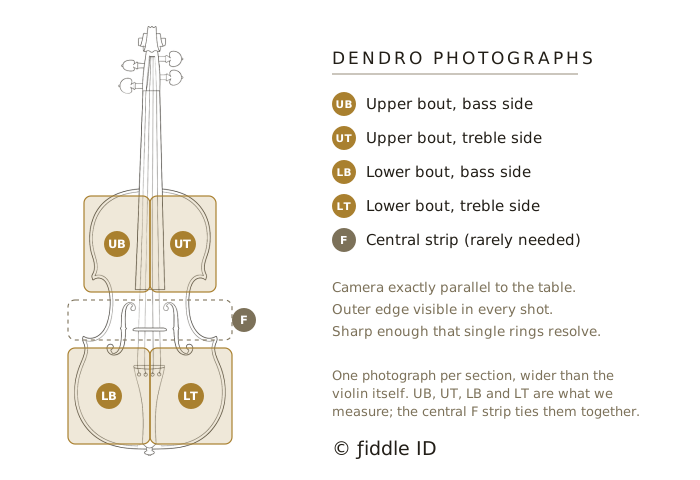
- Provide high-quality images of the table in four sections, as in the diagram below (your phone camera should be sufficient so long as the lighting and focus are acceptable).
- Tag each image for dendro when you upload it.
- The editor checks images are measurable before anything enters the queue; if the images are not acceptable you may be asked to retake them.